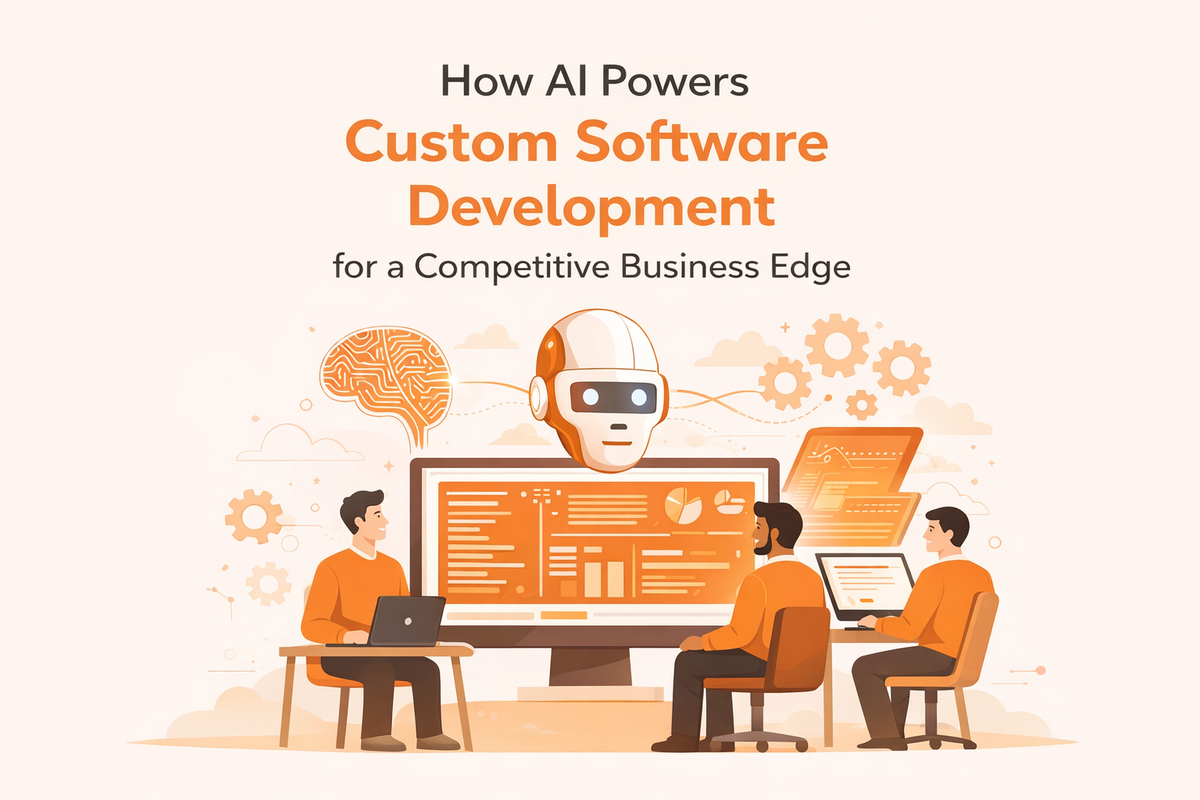
How AI Powers Custom Software Development for a Competitive Business Edge
Until recently, businesses had two clear options when building their technology stack: buy off-the-shelf software to move fast, or invest in custom development to gain control and differentiation. But even today, when AI and low-code tools are changing that equation. Instead of forcing a strict build-or-buy decision, companies now have a third path that blends SaaS, AI-assisted tools, and custom software into a single integrated system.
But despite the rapid rise of AI-driven development, custom software hasn’t lost it’s relevance. In fact, many businesses are doubling down on it.
The reason is simple: AI accelerates development, but it doesn’t replace ownership, context, or strategic fit.
Build, Adopt, or Blend: Choosing the Right Software Path
Sooner or later, every business hits a point where small fixes stop working, and growth demands a bigger decision. And that's the most common point one that shapes how the business competes, scales, and adapts. That’s usually when the software question comes up: whether to build something from scratch, rely on an off-the-shelf product, or find a middle ground?
In recent years, AI hasn’t just entered the conversation; it has quietly reshaped every area from design to development, as its presence is everywhere. Studies now show that 41% of code is AI-generated, a telling sign of how naturally tools like GitHub Copilot have slipped into developers’ everyday workflows.
- Crafting from scratch gives you a system designed precisely for your needs, where every workflow and every feature aligns with your business strategy.
- Adopting off-the-shelf software no doubt saves time and money by providing ready-made tools for standard tasks such as payroll, accounting, and inventory management. These are areas where speed often matters more than flexibility.
For many businesses, starting here is practical and cost-effective. But here’s the catch: most businesses are not “standard.” They have ambitions and growth plans that generic software can’t always support.
That’s why many forward-thinking companies now choose a blended approach: combining AI-powered custom development with select off-the-shelf tools. This hybrid strategy delivers the speed of prebuilt solutions and the innovation and flexibility of custom software, which is the perfect balance to stay ahead of competitors.
AI-Driven Automation and Statistical Realities
Source: Grandview Research
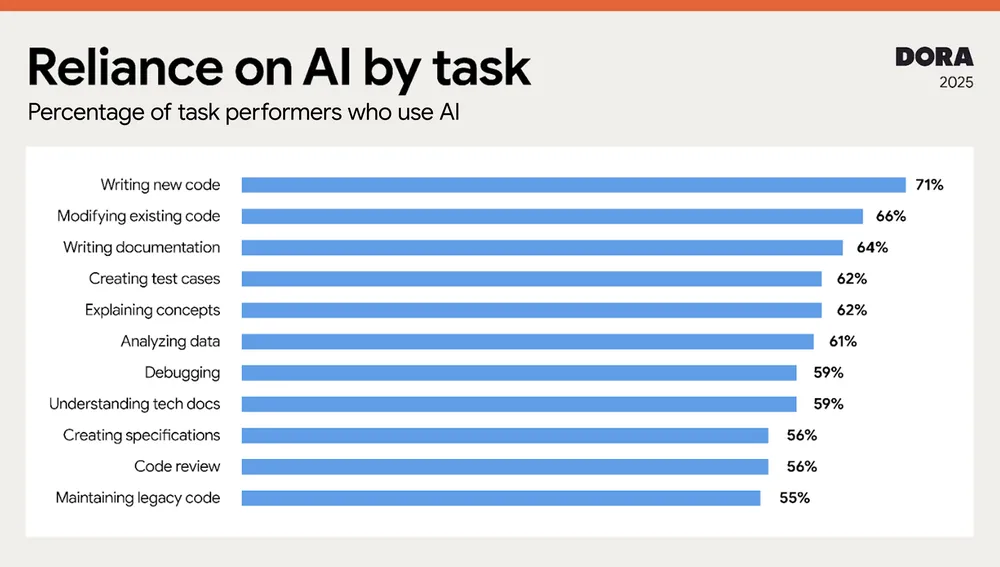
Step into any boardroom today, and one thing is clear: AI is part of the daily workflow in software development. According to the latest DORA insights, 90% of software development professionals now use AI at work. And 80% of developers say AI has directly increased their productivity, helping teams move faster without cutting corners. Even more telling, 65% now rely on AI to some extent in their day-to-day work. Moreover, 59% of developers report that AI has positively impacted their code quality and performance.
Source: Google DORA report
Market Statistics
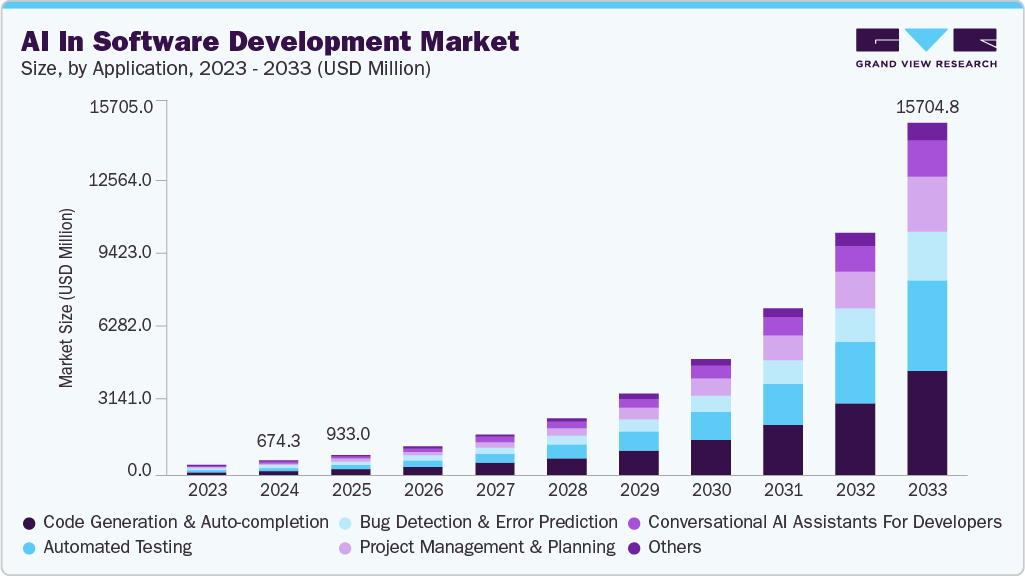
- The global AI in software development market was valued at 674.3 million in 2024 and is expected to surge to 15,704.8 million by 2033.
- The deployment segment led the market with 31.9% revenue, driven by code generation and auto-completion.
- Over the past year, ChatGPT has become the go-to AI for developers, with 82% using it regularly.
- GitHub Copilot took the second spot with 44% of developers using it, while Google Gemini ranked third at 22%
- Big data analytics held the largest market share in 2024, accounting for over 32%.
- Cloud deployment dominated the market in 2024, capturing more than 62%.
Here’s how AI enhances software development:
- Faster development cycles: AI speeds things up by generating code, handling integrations, and running tests in the background.
- Error reduction: Automated testing catches bugs early, making releases more stable.
- Enhanced innovation: Developers spend less time on routine tasks and more on designing features that truly set products apart. The design part is the primary driver of stable income.
Key Benefits of Custom Software with AI
Here are some of the many reasons why businesses today are choosing AI custom software :
Scalability and Adaptability
As businesses expand, software is expected to handle more users, more data, and more operational complexity. This is where AI in custom software does its work, in real terms. Ai models can manages higher workloads and changing requirements without the need for constant redesigns or manual fixes.
AI helps custom software adjust as teams scale and data volumes grow, while staying efficient and reliable. In practical terms, it allows the software to grow alongside the business rather than becoming a hindrance.
Smarter Decision-Making
AI gives custom software the ability to process large volumes of data quickly and accurately, which helps teams make better decisions. By analysing historical data and spotting trends, it turns information into insights that can be acted on immediately. This makes decision-making faster and more reliable, which gives businesses an edge over competitors. Moreover, in planning and estimation tools, AI predicts costs and resource needs, thereby improving long-term planning and decision-making.
Competitive advantage
This gives businesses a real edge over competitors by turning data and insights into actions that matter. A significant number of organisations report that using advanced technology for insights and execution has boosted their productivity, and many see it as a key factor in staying ahead in the market. For example, a survey of business leaders found that 44% of organisations experienced a notable productivity increase and view this kind of capability as crucial to competitive success.
Conclusion
AI is now part of how custom software is built and scaled. It helps teams process data faster, reduce manual effort, and support day-to-day decisions as systems grow more complex. For businesses, custom software that keeps pace with growth rather than becoming a bottleneck.
The advantage comes from applying AI where it creates a measurable impact. Repetitive work is automated, planning becomes more accurate, and developers focus on building features that support growth. Moreover, with the support of an experienced technology partner, AI strengthens custom software from the inside, making it more efficient and better aligned with changing market needs.