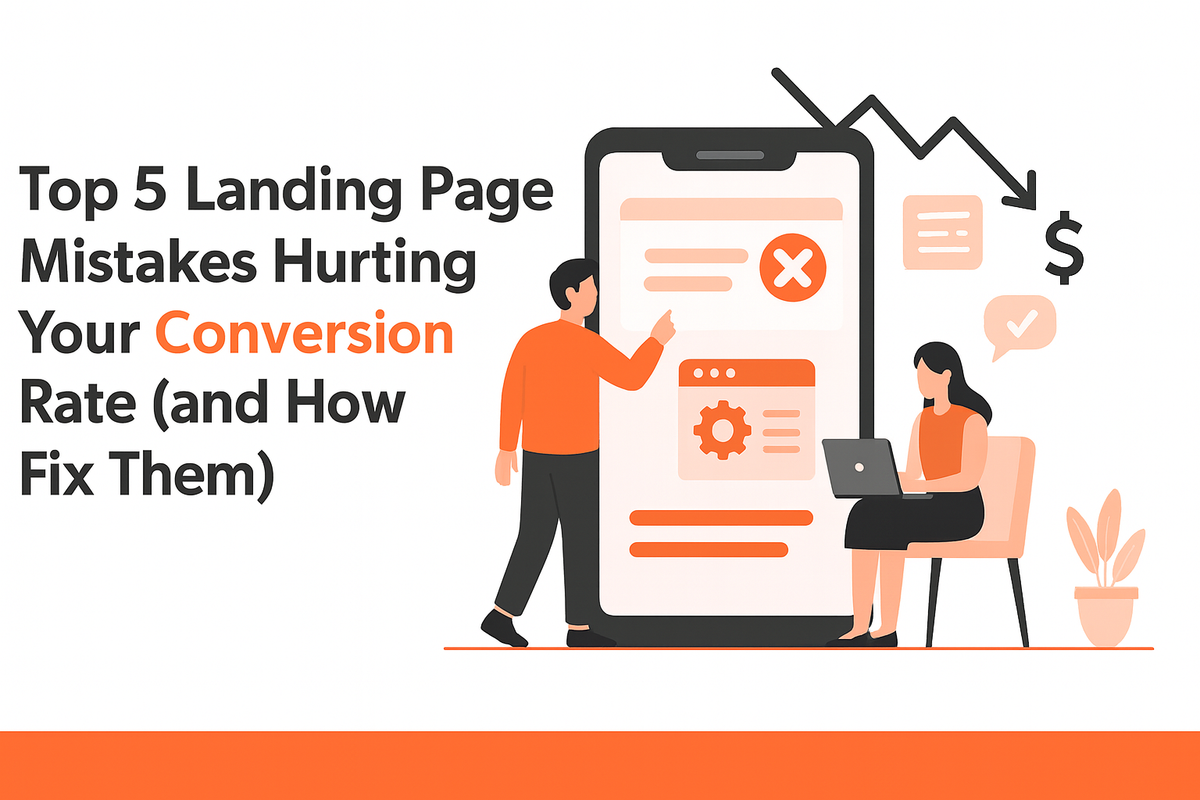
Top 5 Landing Page Mistakes Hurting Your Conversion Rate (and How to Fix Them)
A landing page is designed to do one thing really well: convert visitors into revenue-generating customers. But between the endless design tweaks, copy changes, and “let’s just test this colour” experiments, most end up missing the point.
You might be driving the right traffic, running great ads, and even offering something people genuinely want, yet the conversions just don’t follow. And the truth is, landing pages often fail quietly. Because of small, easily missed mistakes, the kind that make visitors scroll past your offer, hesitate for a second, and click away. In this blog, we’ll unpack a few thoughtful changes that can turn a passive page into a high-performing one.
But before diving into the mistakes, let's just understand why landing pages matter more today than ever. India’s landing page builder market alone is projected to grow from USD 70.3 million in 2025 to USD 324.4 million by 2035, a staggering 16.6% CAGR.
This growth signals one thing: every brand is investing in digital experiences, and your landing page is the first place your customer decides whether you’re worth their time. In a fast-expanding digital landscape like this, even tiny mistakes can cost you conversions, not because your product is wrong, but because your page isn’t working hard enough for you.
Now that you know what you’re competing with, let’s get into the real problem: the five silent landing page mistakes that are quietly hurting your conversions, and how you can fix each one with simple, smart tweaks.
Poor Mobile Optimisation
When your landing page are not compelling enough to keep mobile users front and centre, you’re effectively leaving money on the table. Let’s break down why this matters and how you can fix it.
Key Statistics
- Mobile devices now account for roughly 60-65% of global web traffic.
- Mobile drives 82.9% of visits, with an 11.2% conversion rate, while desktop accounts for 17.1% of traffic, with a slightly higher 12.1% conversion rate.
- If a mobile page takes more than 3 seconds to load, 53% of users will abandon it.
How to Fix
- Keep visuals light and compressed as heavy media slows down mobile loading, and anything above 3 seconds costs you half your visitors.
- Place your CTA above the fold for immediate visibility without scrolling.
- Test on real devices to catch issues first, as Figma or desktop simulations may not always reveal where layouts break.
- Use responsive layout so your landing page fits every screen.
Confusing Navigation & Missing CTA ( Call to Action)
When your landing page forces users to think too much, click around aimlessly, or search for the next step, your conversions take an instant hit. A landing page should guide visitors, not make them guess. If people can’t figure out where to go or, worse, what to do, they simply leave. Make sure every section supports that single goal. Plus, place your main CTA where it’s easy to spot. As simple navigation and clean CTA lead to faster conversion.
Key Statistics
- A clear and specific CTA can lift your conversion rate by as much as 161%.
- Navigation confusion accounts for about 37% of failed conversions.
- A properly placed CTA can lift revenue by nearly80%.
How to fix
- Keep your navigation clean and minimal to reduce bounce rate.
- Place your CTA in a highlighting position where it can be easily spotted.
- Draw visitors' attention with a clear visual flow, colour scheme, and grids that naturally lead the eye to the CTA.
Too Many Conversion Goals
A major reason landing pages lose conversions is too much clutter. When you try to show everything on a single page, like collect leads, drive sales, promote offers, and showcase your brand all at once, you dilute its impact. Instead of leading visitors forward, the page pulls them in different directions. As too many options and multiple CTAs, visitors may get overwhelmed and that usually ends in them bouncing. So it's better when you’re promoting multiple offers, give each its own dedicated landing page, a focused page always converts better than a crowded one.
Key Statistics
- Unbounce found almost a 24% drop in conversions when landing pages use too many long, complicated words.
- The average landing page conversion rate across all industries is 4.3%.
- A well-crafted headline alone can lift your conversions by as much as 307%.
How to fix
- Use clear, concise headlines and subheadings to guide visitors through your page without confusion.
- Remove all distractions from landing page, like extra links, secondary CTAs, or visuals that pull attention away and highlight the single action you want visitors to take.
- Simplify the layout so visitors can instantly understand what you want them to do.
Slow Page Load Time
The objective of most landing pages is to sell, so it's important that your page loads quickly enough for visitors to even see what you’re offering. A slow-loading page works the same way a badly timed ad does; people lose interest before the message appears. Just like remarketing succeeds by showing the right ad at the right moment, your landing page needs to appear instantly to keep users engaged. When the page takes too long to load, your audience simply moves on, no matter how good your offer is. By keeping your design light, optimising images, and reducing heavy scripts, you help your visitors stay focused on your message instead of waiting for it to show up. A fast, responsive page tells users you value their time — and that alone can significantly improve your chances of converting them.
Key Statistics
- Pages that loaded in 2.4 seconds had a 1.9% conversion rate, but at 3.3 seconds the rate dropped to 1.5%.
- A study by PortentPortent shows that pages loading within 0–4 seconds deliver the highest conversion rates
- Studies show that 40% of visitors drop off if a page takes longer than three seconds to load.
How to fix
- Keep your design light and your images optimised so the page loads quickly and visitors stay focused on your message instead of waiting for it to appear.
- Use a fast, dependable hosting setup to keep your page responsive.
- Remove heavy scripts, plugins, and anything that adds friction.
Missing video content
Adding videos to your landing page is a real plus. Even if you already have content and graphics, video takes your message further. You don’t lose the chance to build trust or clarity; you strengthen it. Videos bring the human element your audience needs: a face, a voice, a real story. They make your offer easier to understand and create an emotional connection that static visuals alone can’t deliver.
It can be as simple as showing the person behind your product, featuring a webinar speaker, or adding short brand clips. These small human touches help visitors trust you quicker and stay engaged long enough to convert.
Key Statistics
- Research shows that 38% of marketers consider video the top factor that improves landing page conversions.
- Adding a video has been shown to increase landing page conversions by upto 86%.
- Just 30% of high-converting landing pages use video content.
How to fix
- Use simple brand clips or demos to show the product in action instead of explaining everything through text.
- Place the video near your main CTA, so viewers naturally move toward taking action after watching.
- Add a short 30–60 second explainer video featuring a founder, team member, or webinar speaker to clearly show what you offer and why it matters.
Conclusion
Technology advancements have pushed businesses to rely on smart software and digital tools for smoother day-to-day operations, and your landing page is now part of that ecosystem. Think of it as an extension of your product profile. What you show, what you hide, and how you guide the visitor all shape their first impression. That’s why being intentional with every element matters. As every small improvement adds up, a sharper headline, a cleaner layout, and a CTA that actually stands out. And if better site speed is already on your mind, TechEssentia has your back, helping you turn heavy, confusing pages into smooth, conversion-ready experiences that actually support your business goals.