Private Cloud vs. Public Cloud for HIPAA-Compliant AI: What Healthcare Apps Actually Need
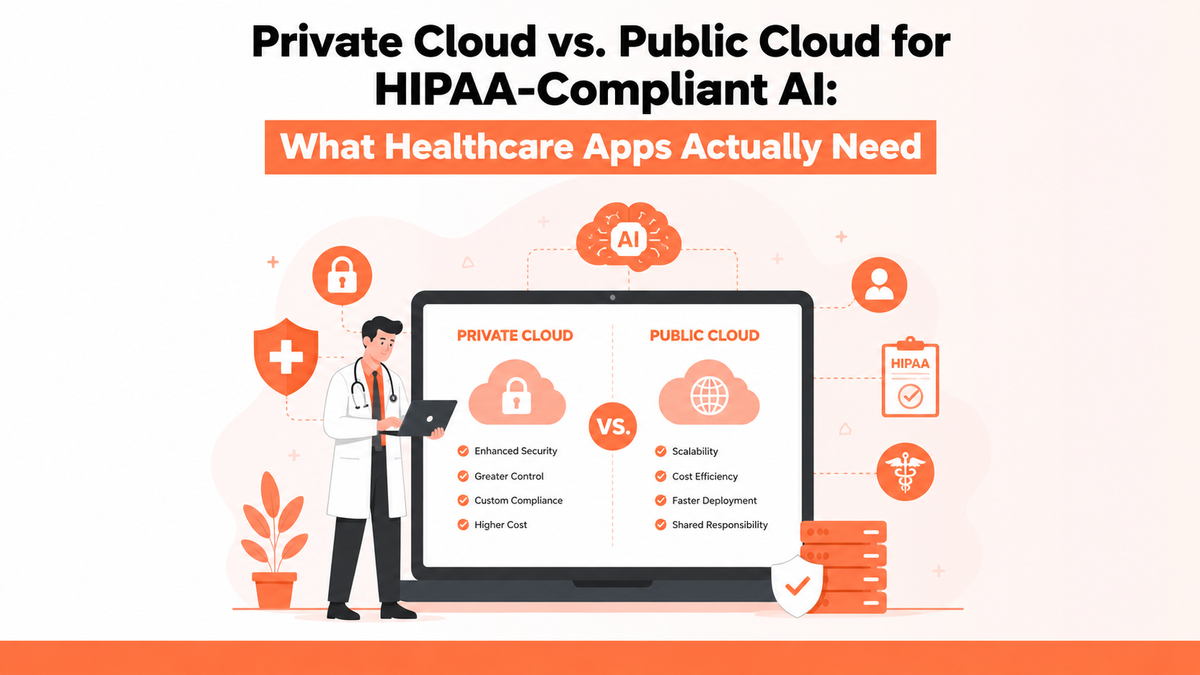
Private cloud holds the largest share of the healthcare cloud computing market, 37.6% as of 2023, ahead of hybrid and public deployments combined, according to Grand View Research. That share keeps growing for a reason most teams never examine closely: an assumption that HIPAA requires it.
That assumption doesn't hold up. Nowhere in the actual text of the HIPAA Security Rule does the phrase "private cloud" appear. What the rule specifies instead is a set of safeguards: encryption, access controls, audit logging, and a signed agreement with anyone who touches the data. Public infrastructure can satisfy every one of those requirements just as completely as private infrastructure can, provided it's configured correctly.
That gap, between what the law actually requires and what gets built anyway, usually traces back to one of a few things: a vendor with infrastructure to sell, a compliance officer erring toward caution by default, or one genuine requirement, training a model directly on raw patient records, getting generalised into a rule for features that never needed it.
The cost of that generalisation runs in both directions. A startup that overbuilds private infrastructure for a scheduling app spends runway it didn't need to spend. A team that underbuilds for a model training on identifiable PHI finds out the hard way, in an audit rather than in a demo.
What follows sorts out where an actual healthcare product falls between those two cases.
What HIPAA Actually Requires (and Doesn't Require) About Cloud Infrastructure
That obligation is precise, according to HHS's own guidance on HIPAA and cloud computing: any cloud provider that creates, receives, maintains, or transmits electronic PHI on a covered entity's behalf counts as a business associate, full stop, whether or not that provider ever sees a readable version of the data. Business associate status comes with its own checklist: a signed Business Associate Agreement, encryption at rest and in transit, access controls tied to individual accountability, and audit logging detailed enough to reconstruct who touched what and when.
Nothing on that checklist calls for dedicated, single-tenant hardware. A shared, multi-tenant cloud environment clears every item on it, provided it's configured correctly and backed by a BAA. So the private-cloud myth has to be coming from somewhere else, and it usually traces to a vendor with infrastructure to sell, a compliance officer erring toward caution, or a separate, legitimate requirement- a state data-residency law, an insurer's contract terms, that gets folded into HIPAA compliance when it was never actually part of it. HIPAA sets the floor. It has nothing to say about the architecture built on top of it.
Public Cloud With a BAA: When It's Enough
All three major providers, AWS, Google Cloud, and Microsoft Azure, will sign that agreement and back it with a defined list of "HIPAA-eligible" services. The phrase gets misread constantly: HIPAA-eligible describes a provider's contractual status for a specific service, not a guarantee that whatever an engineering team builds on top of it is compliant. AWS alone lists more than 150 services under its Business Associate Addendum, and it's direct about the limits of that coverage: there's no such thing as HIPAA "certification" for a cloud provider, and customers remain responsible for ensuring their own compliance on top of it. Configuration, access policy, workforce training, incident response: all of that stays with the customer.
Once that's understood, public cloud with a signed BAA covers a genuinely large share of healthcare products. A telehealth scheduling and video-visit app, the kind of build where development costs and timelines matter more than infrastructure debates, rarely needs more than a properly configured public environment: encrypted storage, standard access controls, and the provider's BAA handle the real risk. A patient engagement or medication-reminder app that reads from an EHR without training on raw PHI falls into the same bucket. Even AI-assisted triage or symptom-checking features usually clear the bar, as long as the underlying model was trained on de-identified or licensed data rather than a live feed of one hospital's patient records.
What connects all three examples is that PHI gets stored, transmitted, and referenced, but never becomes raw training material at scale. That distinction, not the word "cloud," is what actually separates the products that are fine on public infrastructure from the ones that aren't.
When Private Cloud Genuinely Matters
Private infrastructure earns its cost in a narrower set of situations than the market share above suggests, and it's worth being upfront that this is the minority case, not the default one.
The clearest one is a team training or fine-tuning models directly on identifiable PHI, not just running inference against a hosted API. That workload keeps raw patient data sitting in GPU memory and storage in ways that are harder to fully isolate on shared infrastructure, and it's exactly the scenario the HHS cloud computing guidance flags as needing the most careful risk analysis, one that's coming up more often as healthcare AI moves out of pilot programs and into production, part of a broader shift already underway across the industry. A hospital system already running on-premises EHR infrastructure is the second case: a new AI feature that needs tight, low-latency integration with that environment often makes private or hybrid architecture the practical choice rather than the cautious one, especially once EHR integration becomes the real bottleneck. Beyond those two, state data-residency rules, an insurer's contract, or a research partnership can impose requirements that go past HIPAA's baseline, and sometimes an organisation's own risk tolerance is reason enough on its own.
That last reason, tolerance rather than regulation, is more common than the technical requirements alone would predict, which helps explain why private cloud leads the deployment numbers cited earlier even as the broader market, roughly USD 19.6 billion in 2023 and on pace for USD 45.1 billion by 2030 at a 12.7% CAGR, per Grand View Research, keeps expanding across every deployment model. Healthcare organisations choose private more often than their compliance obligations strictly demand, mostly for control and predictability rather than because public cloud can't be made to work.
Cost and Scalability Trade-Offs, Side by Side
For a founder or a hospital IT lead, this stops being a purely technical decision and becomes a budget-and-timeline one just as fast.
Public cloud wins on speed and lowers the bar to launch. Private infrastructure wins on predictability once a workload is large and steady enough to justify the fixed cost. Neither one is cheaper in the abstract; it comes down to how much compute an AI feature actually needs and how consistently it needs it.
A Simple Decision Framework
The more useful question isn't "do we need private cloud." It's three narrower ones.
First: Is the AI feature training or fine-tuning directly on raw, identifiable PHI, or is it running inference against a model already trained on de-identified or third-party data? The former leans private. The latter is usually fine on public cloud with a BAA.
Second: Does the organisation already run on-premises infrastructure, an EHR especially, that the new feature has to integrate with tightly? If so, a private or hybrid architecture usually reduces friction rather than adding cost because it solves an integration problem, not just a compliance one.
Third, and the one teams tend to skip: what's the actual risk tolerance and budget? A well-funded hospital system running a large, steady AI workload on existing infrastructure is making a different calculation than an early-stage startup trying to reach its first paying customers.
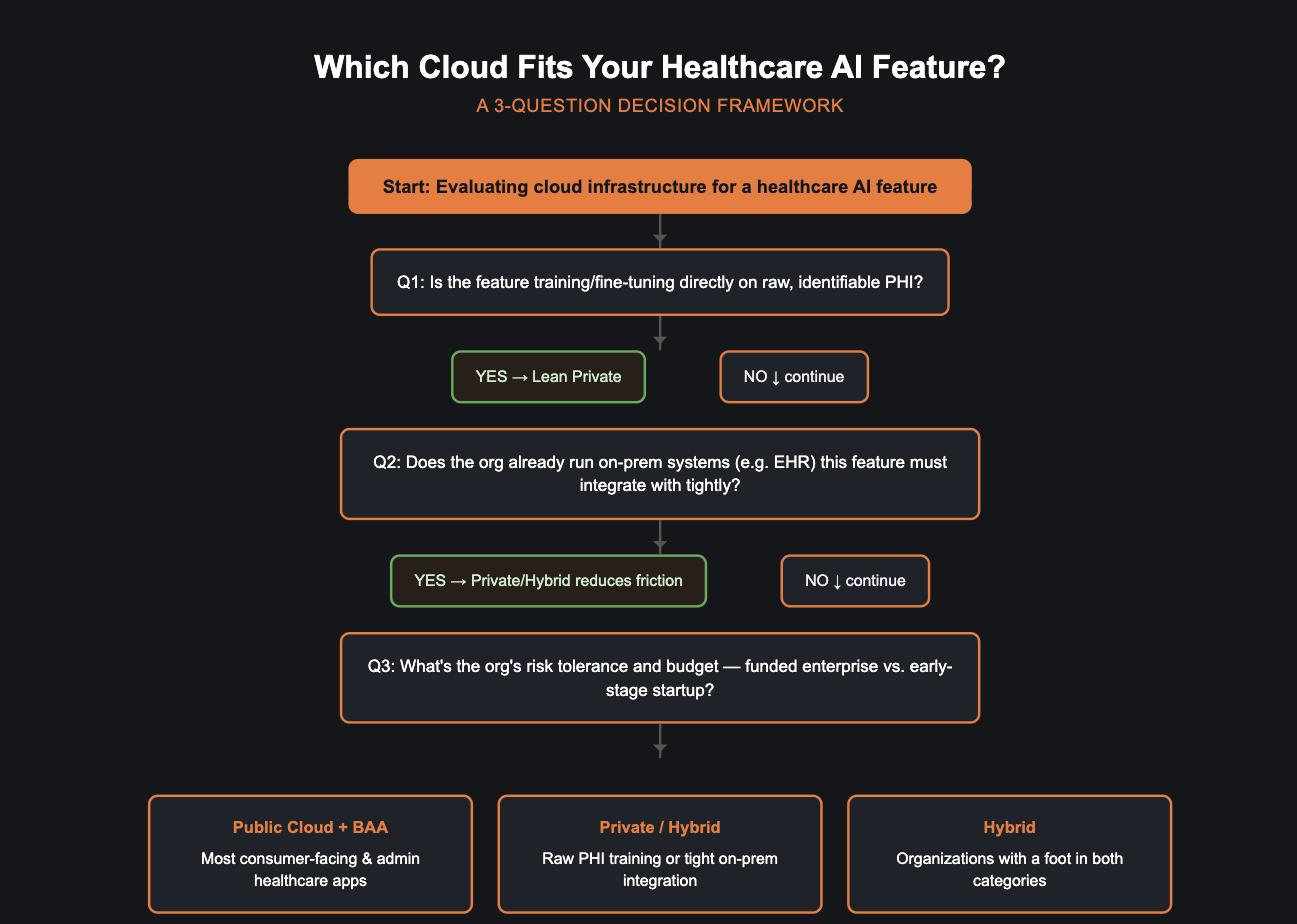
Answer those three honestly, and the recommendation is usually clear: public cloud with a BAA for most consumer-facing and administrative healthcare apps, private or hybrid infrastructure for the subset training on raw PHI or tied to existing on-prem systems, and hybrid as the realistic middle ground for organisations with a foot in both categories already.
How TechEssentia Approaches This for Healthcare Clients
Nearly every healthcare client raises the private-versus-public question in the first conversation, and it's rarely the right first question to answer. Before hosting comes up at all, we map the data flow end-to-end: where raw PHI actually enters a model, versus where the product simply reads and displays records that already exist elsewhere. The infrastructure decision follows from that map. It doesn't precede it. That's the same principle we apply whenever we're designing AI systems that need to hold up under HIPAA: the workload defines the architecture, never the other way around.
Skip that step and a project ends up on one of two bad sides: paying for isolation, a feature never needed, or shipping the one workload that actually required it without the protection to match. Do it in order, and the hosting decision stops being a guess and starts being math.
If a healthcare product is at the point where this call has to be made, let's talk. We'll walk through the data flow first, before recommending anything.