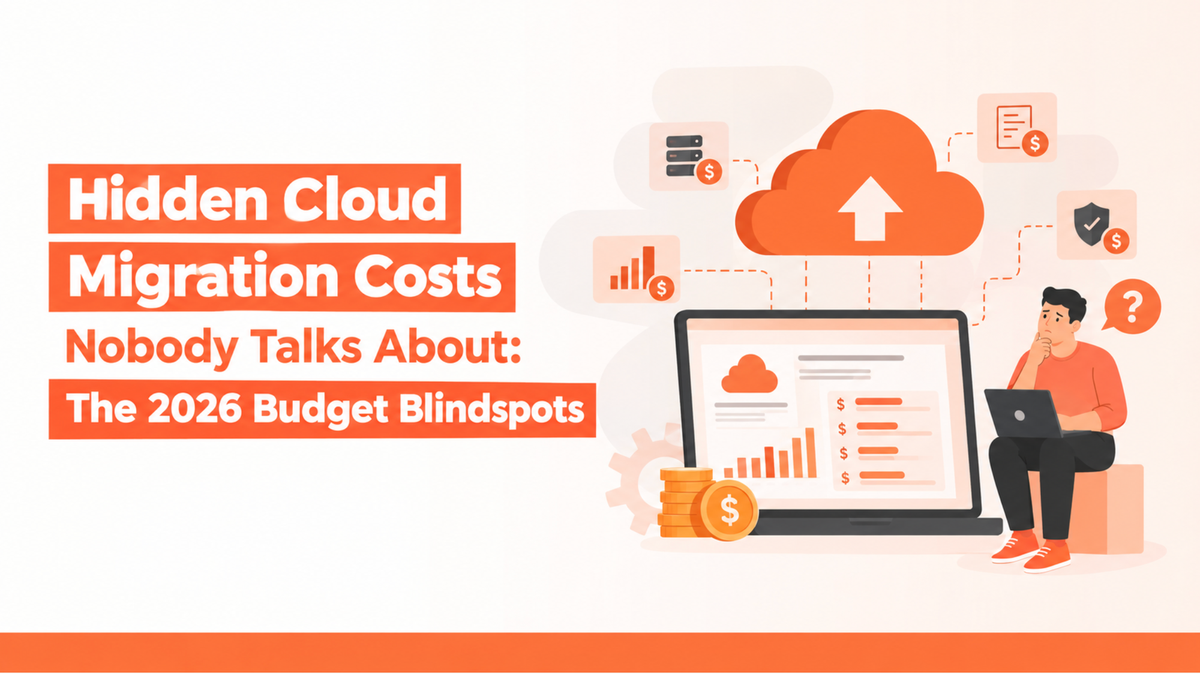
Hidden Cloud Migration Costs Nobody Talks About: The 2026 Budget Blindspots
Most cloud migration budgets are wrong the day they get approved, and usually by more than anyone in the room wants to admit. The estimate that gets signed off rarely reflects what the project will actually cost; it reflects a compute price multiplied by a server count, presented with more confidence than the number deserves. For a long time, that gap was manageable, because it showed up in small, forgivable ways: a bit of extra egress, a license nobody remembered to cancel, an observability bill that crept up slowly enough to escape notice — until 2026, when wasted cloud spend jumped to 29 percent this year, according to Flexera's 2026 State of the Cloud Report, after five straight years of that number falling. What makes the timing strange is that it happened right as companies built more cost oversight than they've ever had, with 63 percent now running a dedicated FinOps team and 71 percent operating some form of cloud centre of excellence. More oversight was supposed to mean less waste, but waste went up alongside it, which is the part worth sitting with.
Here's why it's happening, and where the money is actually disappearing.
The First Mistake: Treating Two Budgets As One
Migration cost and infrastructure cost are not the same number. Most teams treat them as the same, and that's the root of almost every blown budget I've seen.
Migration cost is what you pay once: discovery, redesigning the architecture, moving the data, testing it twice, and stabilising the cutover; infrastructure cost is what you keep paying every month, for as long as the platform runs. Mix the two into one line on a slide, and you've built a number that's wrong about both.
The honest version adds up migration services, running old and new systems side by side, data transfer, ongoing operations, security, AI platform costs, and a contingency buffer that isn't there just for show. Skip one of those, and you haven't saved time — you've moved the shortfall to next quarter's invoice, which is exactly what shows up in the wider numbers: IDC found that 38 percent of cloud migrations exceed their original budget, with the average overrun landing around 23 percent, while Gartner's figure runs even higher, at close to 60 percent of organisations going over their initial migration budget, sometimes by 30 to 50 percent. Those two numbers describe less bad luck than the same missing line item showing up in survey after survey.
The Second Mistake: Forgetting You're Paying For Two Systems At Once
Almost every real migration goes through a stretch where the old system and the new one are both running, sometimes for a few weeks and sometimes for months, usually because someone finds a dependency nobody wrote down.
During that window, you're paying twice: duplicate compute, duplicate storage, database replication humming in the background, licenses you thought you'd already cancelled, and the overtime that shows up like clockwork the week of cutover. None of that is hard to predict, which is exactly why it should be its own line in the budget instead of what it usually becomes: a cost buried inside a bigger number, invisible until the invoice makes it visible.
The Third Mistake: Ignoring The Cost Of Moving Data Around
Everyone scrutinises storage pricing, because it's the obvious number on the invoice. Almost nobody scrutinises the cost of moving that data out of a provider, across regions, or back to an on-prem system—and that blind spot is exactly where the bill runs over, since cloud providers meter transfer separately from storage, not as one flat fee.
The reason it slips through is simple: pilots don't move real volumes of data, so this cost stays invisible during testing. It only shows up once the system is live and carrying real traffic, which means that by the time it appears, the project has usually already been called a success.
The Fourth Mistake: Watching The Wrong AI Bill
This is the one catching even experienced teams off guard right now, and it starts with a simple mix-up: everyone talks about the cost of training an AI model, because it's the headline number. But the cost that never stops is inference, the price of actually running that model for real users, every request, for as long as the product exists. Forbes Technology Council contributor Nishanth Prakash frames it well in his piece on this exact shift: training is a one-time bill, while inference is a subscription you didn't realize you'd signed up for.
That framing plays out in a story worth repeating. One company's AI tool cost about two hundred dollars a month to run while it was still in development. Once real users adopted it, that climbed to ten thousand dollars a month—not because anyone budgeted badly, but because success itself broke the bill.
That same pattern scales up fast. SemiAnalysis estimates that running a model like GPT-4 in production can cost roughly seven hundred thousand dollars a day, well past the hundred-million-dollar figure everyone quotes for training it in the first place. Put those two numbers side by side and the lesson writes itself: the number everyone talks about was never the real number.
Why does this catch people off guard specifically? Because training and inference behave differently, training is bursty, so you can schedule it, pause it, use cheap interruptible capacity, and pick it back up later, while inference doesn't offer that flexibility, since real users don't pause for a discount window. A low-traffic feature might survive on a cheap, shared API, but anything with real volume needs dedicated capacity, and that single decision can turn a three-digit monthly bill into a six-digit one.
Here's what that looks like in raw compute terms: running an eight-GPU H100 training setup for about 100 hours costs roughly $8,800 on a major provider's high-end instances, before storage, data processing, failed runs, or the retries that always happen. That's just training, and training ends, while inference is the meter that keeps running long after everyone's forgotten the training job even happened.
The Fifth Mistake: Treating Security As A Phase Two Problem
Under deadline pressure, security controls always seem like something to add later. That instinct gets expensive fast in a system where AI touches real production data, and the cost of waiting doesn't rise in a straight line, it compounds, because bolting security onto a system that's already live costs far more than building it in from day one.
That's why identity management, secrets management, audit logging, data classification, and increasingly the security of prompts and model access need to sit in the initial plan, not a follow-up sprint. Sequencing matters more than the tooling.
The Sixth Mistake: Letting Logs Pile Up
Logging feels invisible right up until it isn't. Application logs, audit trails, AI inference logs, all piling up quietly, and if none of it gets tiered or aged out, retention becomes one of the biggest line items in a modernised system without anyone actually deciding it should be, it just accumulates until someone notices the bill doesn't look like it used to.
The One Fix That's Actually Free
Here's some good news: the tools to fix a lot of this already exist, and using them costs nothing beyond the discipline of asking for them. Committed-use pricing can cut compute costs by up to 72 per cent compared to paying on demand, and interruptible, spot-style capacity, or work that can handle being paused, like training jobs that checkpoint, can cut costs by up to 90 per cent.
And yet fewer than half of companies use even one of these discount programs, according to Flexera's own research—and the reason comes from a different survey entirely. The FinOps Foundation's 2026 research found that 64 percent of enterprises name cost forecasting as their single biggest challenge, which puts the two findings together into a clearer picture: teams aren't skipping these discounts because they don't trust them, they're skipping them because nobody's confident enough about next quarter's usage to commit to anything.
Conclusion
Cloud migration cost in 2026 should be treated as an ongoing financial commitment, not a one-time infrastructure quote. Organisations need to budget for migration engineering, temporary dual running, data transfer, security, observability, and AI inference costs together, as one financial model, rather than as separate surprises that show up one at a time after the bill arrives.
An AI-ready cloud budget also needs a different centre of gravity than a traditional migration one. It should be built around inference cost, not training cost, since that's the number that keeps running long after a feature ships and determines whether it stays affordable once real users show up.
Planning a cloud migration or building AI-ready infrastructure? Talk to TechEssentia's team for a workload-level cost assessment and a realistic migration budget built around your applications, data, and growth plans, not a generic estimate that falls apart the first month after go-live.