The 90-Day AI Roadmap: Why Most Companies Never Finish One
Most companies have already adopted AI in some form. Getting it to actually pay off is a different problem, and it's the one almost nobody has solved yet.
McKinsey's 2025 State of AI survey found that 88% of organisations now use AI somewhere in the business, up from 78% a year earlier. That part isn't really in question anymore. What happens next is: only 39% of those same companies say AI has affected their bottom line at all, and most of them are talking about less than 5% of EBIT.
MIT dug into that specific gap. Its State of AI in Business 2025 study found that 95% of enterprise generative AI pilots fail to deliver a measurable financial return. In other words, the pilot stage — the part that's supposed to prove an idea works — is exactly where most of the value gets lost.
Gartner's data points to why. Its 2024 forecast predicted that at least 30% of generative AI projects would be abandoned right after proof of concept, citing specific reasons: data that wasn't ready, no one clearly owning the outcome, and costs that ran past the budget. None of that is really about the technology. It's about planning, or the absence of it.
Ninety days, done with some discipline, is enough time to close that gap. Not with a year-long transformation program — just with a plan simple enough to actually follow: one problem, one owner, one way to know if it worked. Here's what that looks like.
Key takeaways:
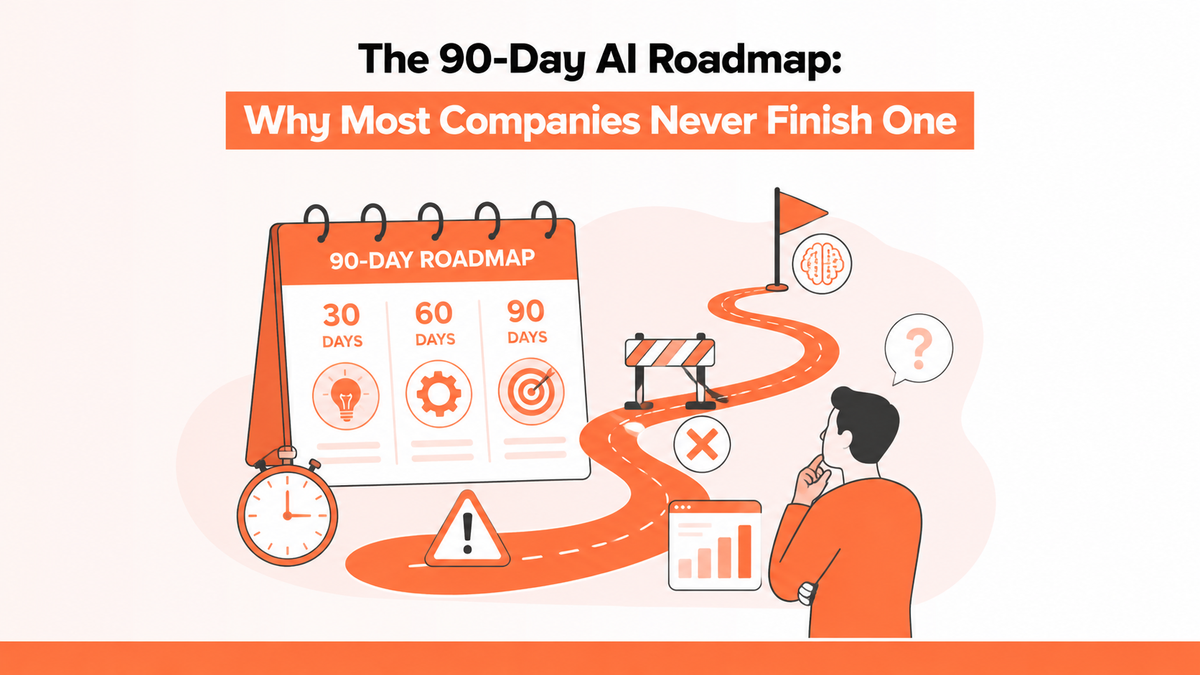
- A 90-day AI roadmap works in three phases: readiness and use-case selection (days 1–30), building and testing a pilot (days 31–60), and a phased launch with real measurement (days 61–90).
- The first project should be narrow and boring, not ambitious, something with clear data and clear value, not a company-wide reinvention.
- Baseline metrics defined on day one are what separate a pilot you can prove worked from one that just quietly fades out.
- Most 90-day roadmaps fail for the same handful of reasons: treating AI as a software purchase, skipping data-quality work, chasing visibility over feasibility, and never setting numbers to measure against.
What an AI Roadmap Actually Has to Answer
Forget the tool list. That's not where a real AI implementation plan starts. A roadmap is a sequence of decisions that ties one business problem to one measurable outcome, with built-in checkpoints so you catch issues early if something's off. Before anyone signs a vendor contract or opens a coding environment, it's worth answering a few plain questions:
- What problem are we actually solving — and what does "it worked" look like in numbers, not opinions?
- What data do we already have, and is any of it usable right now?
- Who inside the company owns this — not just an executive sponsor, but the people whose day-to-day work is about to change?
- What counts as real progress at day 30, day 60, and day 90?
Ninety days works as a window for a simple reason. It's long enough to build and test something real, and short enough to force actual decisions. Give a team a year, and they'll spend the first six months in planning meetings. Give them ninety days and a real deadline, and they tend to ship.
Days 1–30: Get Honest Before You Start Building
Nothing gets built in the first month, and that's the point. This stretch is about making sure whatever comes next has a real shot at working, instead of turning into one more abandoned pilot nobody brings up again.
Run an honest AI readiness assessment
Start with data quality, existing systems, and whether your team has the technical bandwidth for this — before you take a single vendor call. It matters that early because most AI projects don't fail from a weak model. They fail because the data has been scattered across three systems that never talked to each other, and nobody noticed until week six. Better to find that out in week one, while it's still cheap to fix.
Get real stakeholder alignment
This is more than getting a budget approved. It means:
- Naming someone senior enough to protect the project once other priorities crowd in
- Talking to the people whose jobs are about to change — the support team, the ops staff, whoever ends up using this tool every day
- Agreeing, in writing, on what success looks like before anyone starts building
Skip that conversation, and you'll end up with a technically sound pilot that nobody on the ground wants to touch.
Pick a narrow, well-defined use case
Resist anything pitched as a total reinvention of how you serve customers. Picture a mid-size clinic buried in incomplete patient intake forms, or a regional lender whose ops team manually reconciles flagged transactions every morning. Neither problem is exciting. Neither would look good on a slide. But both are the kind of narrow, data-available problem you can actually finish in one quarter with an AI agent handling the repetitive part of the workflow, which is exactly why they're worth choosing over something bigger and vaguer.
Weigh candidates on two things only: how much value they'd create, and how hard they'd be to build. Start with whichever lands in high value, lower difficulty. The point of this first project isn't to transform the business — it's to prove, to everyone watching, that this can work at all.
By day 30, you should have: a written AI readiness assessment, a named owner and team, one use case chosen for the right reasons, and a baseline number you'll measure everything against later.
Days 31–60: Build Something People Actually Use
This is where the idea turns into software.
Decide how you're building it
That choice shapes everything after:
- Off-the-shelf tools get you moving fast, but you won't look any different from every other company using the same one.
- Fully custom builds give you more control and something harder to copy, but cost more time and money upfront, though AI is changing what a custom build actually looks like, often faster than it used to.
- Adapted platforms — an existing model customised around your workflow and data — are where most first pilots actually land.
This is also usually the point where it makes more sense to bring in a development partner who's done this before than to build an in-house AI team from scratch in thirty days.
Work in short, visible sprints
Two-week cycles, with something real to show at the end of each one, is a reasonable rhythm. It's a lot easier to catch a wrong turn after two weeks than after two months of heads-down building, and a lot cheaper to fix.
Test with real people and real data
Not a demo built on the five cleanest examples you could find. The friction that shows up the moment an employee tries this on actual customer records is the most useful feedback you'll get in the whole project. Treat it that way instead of brushing it off.
By day 60, you should have: a working pilot in front of real users, at least one round of their feedback already built in, and an honest read on whether this use case is worth continuing.
Days 61–90: Launch, Measure Honestly, and Decide What's Next
The last month is about finding out, with real numbers, whether this was worth doing — and building the next step regardless of the answer.
Roll it out in phases
Start with a smaller group, not everyone at once. A phased launch — one team, one region, one workflow — surfaces integration problems while you still have room to adjust or pull back, without the whole company watching. Go company-wide only once that smaller rollout has actually held up.
Measure against your original baseline
Not whatever number makes the project look best in hindsight. That means reporting on:
- Time saved per task
- Error rate or quality changes
- Resolution speed or throughput
- Revenue or cost actually touched
And it means counting the ongoing cost of running the thing — hosting, monitoring, upkeep — not just what it cost to build.
Document what comes next
Write down what you'd do differently while it's still fresh, and name the next use case in line. A pilot that ends at day 90 without a next step isn't really a roadmap. It's a one-time experiment that happened to work.
By day 90, you should have: a live result backed by real numbers, and a documented next use case ready to go.
Where 90-Day AI Roadmaps Usually Go Wrong
Mistake 1: Treating it as a software purchase. The tool is rarely the hard part — getting a team to trust a new workflow is.
Mistake 2: Skipping the data-quality work. It feels less exciting than picking a model, but it tends to surface as a painful surprise around week six instead of week one.
Mistake 3: Choosing the flashiest use case, not the most realistic one. A highly visible project built on shaky data is a far worse bet than a smaller one that actually ships.
Mistake 4: Starting without baseline numbers. This makes it nearly impossible to prove the thing worked later, which is usually the real reason a project never gets funded for round two.
A 90-Day AI Roadmap at a Glance
Frequently Asked Questions
Can a smaller business actually pull this off in 90 days? Often more easily than a large enterprise, since there are fewer approval layers and less legacy infrastructure to untangle. The main requirement is to pick something narrow enough to finish, not to try to overhaul three departments at once.
Do we need an in-house AI team before we start? No, not for a first pilot. Most companies work with an outside development team for the build and testing phases, then decide how much of that capability to bring in-house once there's real evidence it's worth the investment.
What happens if the pilot just doesn't work? That's a valid outcome, not a failed project — provided you defined success criteria at the start. Finding out, with real data, that a use case isn't worth pursuing is more useful than another year of debating it in meetings.
What should a 90-day AI pilot actually cost? It depends heavily on scope, and on whether you're building on an existing platform or from the ground up. The number worth planning around isn't the build cost alone — it's the ongoing cost of hosting, monitoring, and maintaining it, which is what most early estimates leave out entirely.
What's the biggest predictor of whether a pilot survives past 90 days? A clear owner and a baseline metric, set before building starts. Pilots that skip both tend to quietly fade out even when the underlying technology works fine.
Bringing Your AI Roadmap to Life
A 90-day AI roadmap works because it forces focus: one problem, one team, one metric to measure, tested in production rather than in a slide deck. Budget size isn't what separates the companies getting genuine value from AI right now from those still stuck in pilot mode. It's that they picked something small enough to finish, and stayed honest with their own data about whether it worked.
If you're working through your first 90 days and want an experienced team to help scope, build, and launch the pilot, TechEssentia's team can walk you through it.