Top Fitness & Wellness App Development Companies in 2026
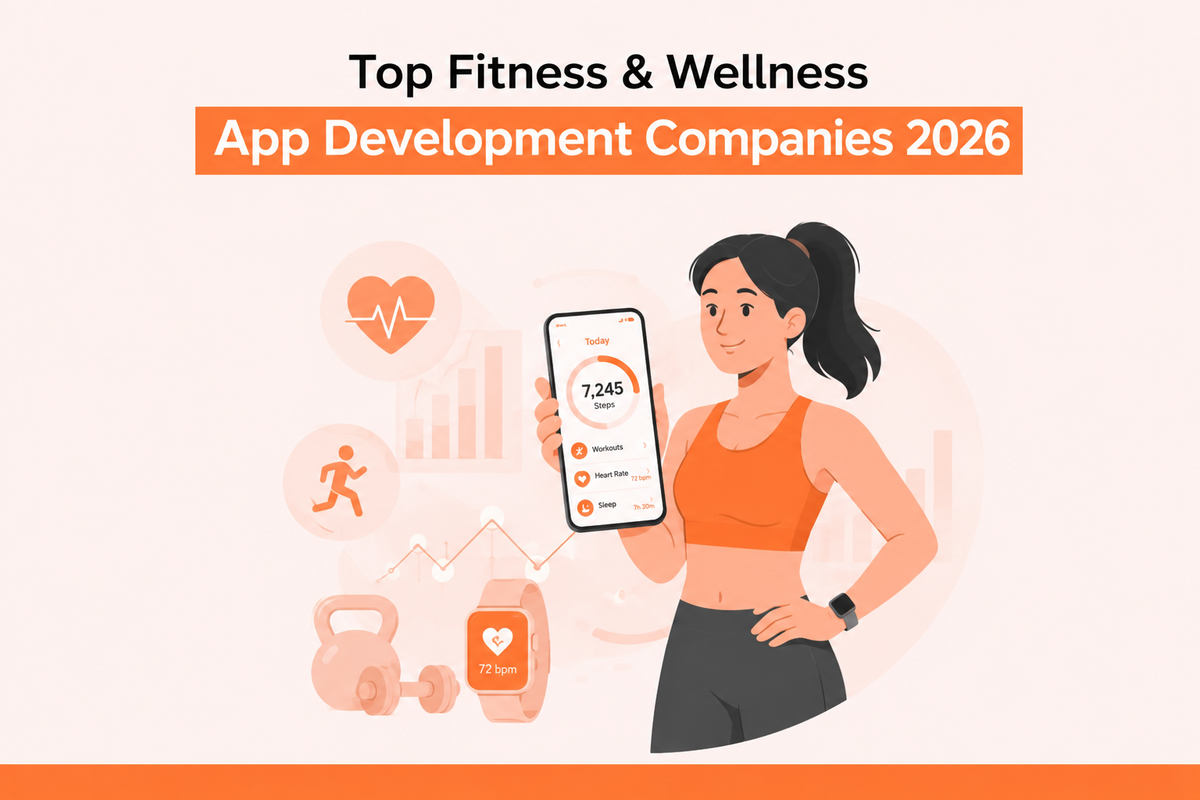
Forget about fitness apps that just count your steps; the category has quietly moved on, and most businesses building in this space haven't caught up. Today's fitness apps don't just log a workout or a calorie count; they rebuild a training plan based on how someone slept last night, sync with a wristful of wearables, and flag a recovery problem before a user even feels it.
These apps are no longer just workout trackers with a nice interface. They're becoming full-health products, and the businesses behind them are being held to a much higher standard. And the best part is that Users are becoming active participants in their own fitness journeys rather than passive scrollers checking their step counts.
Imagine an app that reads someone's sleep score, rebuilds today's workout around it, and quietly shares the right data with a coach or provider and that too without a single manual entry. The right development partner makes that possible, and the future of fitness apps looks a lot smarter (and a lot more personal) because of it.
According to Grand View Research, the global fitness app market is valued at roughly 13.9 billion in 2026 and is projected to grow significantly, reaching an estimated 33.6 billion by 2033, at a 13.4% CAGR. And behind that growth is an even bigger number: global smartwatch users have already surpassed 640 million.
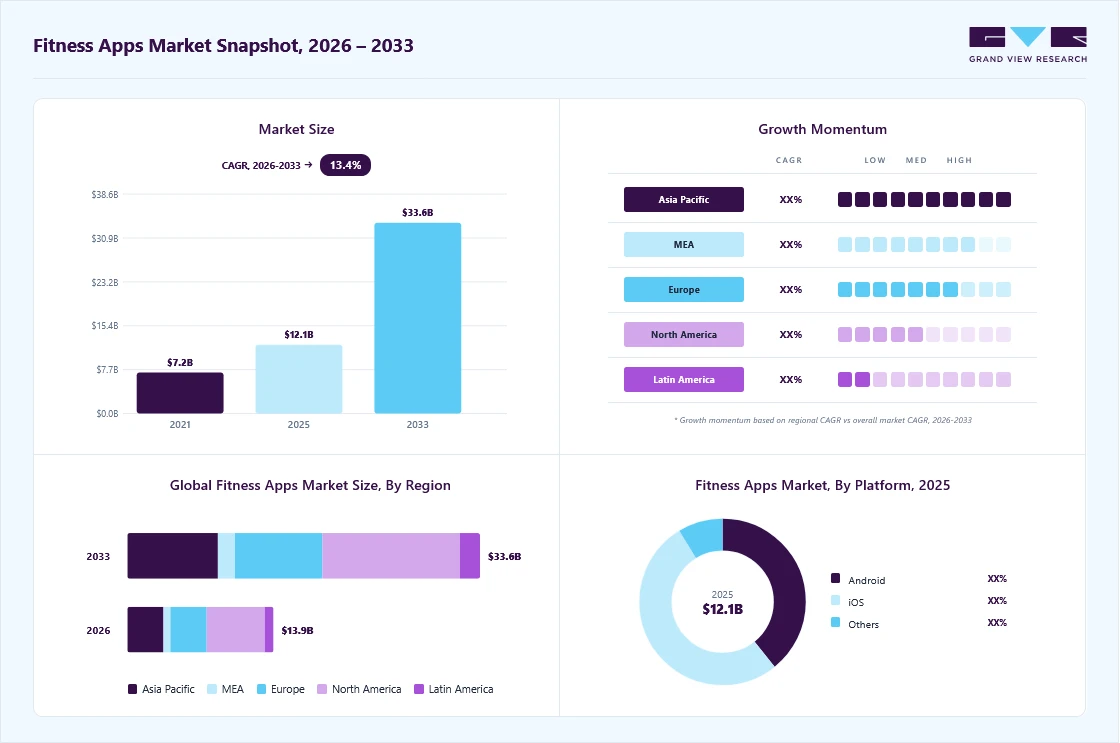
Source: Grand View Research
Key Takeaways
- AI personalisation is expected now, not a bonus. A plan that adjusts to how someone slept last night will always beat a static 12-week PDF.
- The compliance picture changed quietly. Since July 2024, the FTC's amended Health Breach Notification Rule covers fitness, fertility, and mental-wellness apps even when HIPAA doesn't apply, and most teams building in this space still don't know it.
- Wearable integration has to be built in from day one. Add it later, and a team ends up rebuilding the backend instead of shipping a feature.
- Phone cameras can now correct form — counting reps, catching a rounded back mid-lift, and that's turning into a real advantage in strength, yoga, and rehab apps.
- This list intentionally includes both large firms and smaller studios. TechEssentia sits on the smaller side: a senior team that builds fitness and wellness apps end-to-end, with real experience handling sensitive health data, not a company that added "fitness" to its website this quarter.
Why Fitness Apps Are Harder To Build Than They Look
A decade ago, a fitness app's job was simple: log workouts, count calories, move on. That bar has moved fast, and most of the real difficulty now lives in the parts a user never sees.
Start with personalisation. A generic 12-week PDF doesn't hold anyone's attention anymore. Users expect a plan that adjusts to yesterday's sleep score, today's soreness, and a goal that shifts every few weeks, and that takes real machine learning work on training and recovery data, not a rules engine dressed up as "AI."
Plus, the Wearables raised the bar next. Apple Health and Google Fit became table stakes years ago; the harder engineering now lives in Garmin, WHOOP, and Oura, and increasingly in recovery hardware, connected cold plunges, saunas, and massage guns that ship with their own APIs. Teams that treat any of this as a "phase two" feature almost always end up rebuilding their entire data pipeline later, once it's no longer cheap to fix.
Then comes the part almost nobody budgets for: compliance. HIPAA still applies to any app working with a clinical or insurance partner. But since July 2024, the FTC's amended Health Breach Notification Rule has quietly pulled ordinary consumer fitness, fertility, and mental-wellness apps into breach-disclosure territory too, with a 60-day notification window that applies even outside HIPAA. Very few development shops mention this up front. It's worth flagging before it turns into a legal problem instead of a technical one.
Computer vision is changing what "tracking" even means. A phone camera can now count reps, flag bad squat depth, or catch a rounded back mid-deadlift without a single extra sensor. It's showing up most often in strength training, yoga, and physical therapy apps, where form errors are exactly what cause injuries and drop-off.
And then there's scale, which has a habit of showing up exactly when a business can least afford it. A live class, a viral fitness-challenge clip, or a seasonal New Year rush can send concurrent users up tenfold overnight. Apps that weren't architected for that load don't degrade gracefully; they crash at the exact moment they were supposed to prove themselves.
How We Evaluated These Companies
Ranking firms by size or marketing budget would have been the easy way out, and it wouldn't have told anyone much. Instead, every company on this list was measured against what actually matters once a fitness or wellness build gets real:
Top 10 Fitness App Development Companies in the USA
TechEssentia
TechEssentia earns the top spot for a simple reason: it treats fitness and wellness apps as real health products first, not just workout trackers with a nice interface. The team builds custom training apps, activity-tracking platforms, habit and nutrition tools, and full wellness ecosystems that connect natively with Apple Health, Google Fit, Apple Watch, Fitbit, and the broader wearable app development landscape. Where TechEssentia pulls ahead is in what lies beneath the app: AI-assisted personalisation, cross-platform engineering, and health-data handling built to withstand scrutiny, sharpened by hands-on delivery on regulated healthcare projects. That combination of polished UX and disciplined backend engineering is why both startups and growing wellness brands keep coming back for long-term platform growth, not just a one-off build.
Best for: AI-powered fitness apps · startup and mid-size brand platforms · wearable integration. Digital health and wellness products · HIPAA-ready apps
Key features: AI workout and wellness recommendations · Apple Health and Google Fit integration · Apple Watch, Fitbit, and Garmin connectivity · custom iOS and Android development · cross-platform builds (React Native, Flutter) · secure health data management · end-to-end product strategy
MobiDev
MobiDev has built a genuine speciality in computer-vision-driven fitness apps, the kind that count reps or catch bad form through a phone camera and has worked with more than 50 sports and fitness clients since 2020, backed by a 5/5 rating on Clutch. If your product idea relies on AI-powered form correction or motion tracking rather than a standard tracker-and-plan format, MobiDev's portfolio supports that.
Best for: computer-vision fitness features · AI-driven motion tracking · startups building a technically ambitious MVP
Riseapps
Riseapps has built a strong reputation specifically in healthtech and fitness, backed by one of the higher Clutch ratings in this space (4.9/5 across 58+ reviews). Their focus tends to run toward telehealth-adjacent and remote-monitoring style fitness products, which suits founders whose apps sit close to a clinical use case.
Best for: healthtech-adjacent fitness apps · remote monitoring and telehealth crossover products
Softeq
Softeq's edge is hardware-plus-software: the company has been building connected products since 2009 and is comfortable designing the full stack behind a wearable ecosystem, not just the mobile app that talks to it. If your fitness product involves a custom device, not just integration with an existing wearable, Softeq is worth a conversation.
Best for: connected fitness hardware · IoT-enabled wellness ecosystems · device-plus-app product lines
Interexy
Interexy has built a solid mobile development track record with a Clutch rating around 4.9/5 across 67+ reviews, and counts fitness and wellness apps among its regular project categories. It's a dependable mid-size option for founders who want an experienced team without an enterprise-consultancy price tag.
Best for: mid-budget fitness MVPs · founders who want mobile-engineering depth without enterprise overhead
Net Solutions
Net Solutions has built up meaningful healthcare and wellness experience alongside its broader digital product work, including projects that required HIPAA-aware data handling. That makes them a sensible option for wellness products that sit close to a regulated healthcare use case.
Best for: HIPAA-adjacent wellness platforms · digital health products with a compliance component
Konstant Infosolutions
Konstant has been in mobile app development for close to two decades and has a broad portfolio that includes fitness and activity-tracking apps among its healthcare and lifestyle work. It's a reasonable fit for founders who want an established shop with a long delivery track record rather than a boutique specialist.
Best for: founders who value longevity and a broad delivery history · standard fitness/activity tracker builds
Belitsoft
Belitsoft brings strong backend and cloud engineering experience to healthcare and wellness projects, and has handled data-heavy builds where scalability and secure storage matter as much as the front-end experience. Good option when the toughest part of your app is what happens on the server, not the UI.
Best for: data-intensive wellness platforms · backend-heavy fitness products (analytics, large user bases)
Chetu
Chetu is a much larger outsourcing firm with a dedicated healthcare and wellness vertical, useful for founders who want a big bench of specialists on tap rather than a tight core team. It suits larger wellness brands or corporate wellness programs more than early-stage fitness startups.
Best for: enterprise or corporate wellness programs · larger fitness brands needing a big delivery bench
Fingent
Fingent rounds out the list with solid custom software chops and healthcare-sector experience, including projects that required careful handling of patient or user health data. A safe, steady option for a straightforward fitness or wellness build without a highly specialised feature set.
Best for: straightforward fitness/wellness app builds · founders prioritising stability over specialisation
How To Actually Choose Between Them
Picking a development partner for a fitness app rarely comes down to whoever has the flashiest case study. It comes down to whether a team has actually built something like this before and stuck around to see what happened after launch.
A good test: ask what happened to user retention 90 days after a past fitness or wellness build went live, not just what the demo looked like on day one. Teams that have only worked on generic mobile projects tend to underestimate how fast a workout app loses users once the personalization or wearable sync feels bolted on. Teams that have actually shipped in this category usually have a specific answer ready, not a vague one.
Wearable sync deserves a real technical conversation, not a yes-or-no question. Plenty of teams will say they've "integrated Apple Health." Fewer can explain what happens when a user's Fitbit and Oura ring report conflicting heart-rate data, or how the app behaves when a connection drops mid-workout. A straight answer here tells you more than a portfolio slide ever will, and it's worth asking about directly through the lens of how wearable integration actually gets built, not just demoed.
If the product touches health data in any real sense, ask about HIPAA and the FTC's newer breach-notification rules before getting to pricing. Fixing a compliance gap after a security review flags it is slow and expensive; building it into the first sprint almost never.
Then push on scale, specifically. A fitness app that handles a couple thousand beta users smoothly can still collapse the day a workout challenge goes viral or a gym runs a seasonal promotion. Ask what a team has actually seen break under real traffic, not just what an architecture diagram claims it can handle.
A team that clears all four of these is usually the one that sticks with fitness app development, from the first release through years of growth, not just ships version one and disappears.
Conclusion
Fitness apps in 2026 live or die on a handful of things: how personal they feel out of the gate, how cleanly they sync with whatever's already on someone's wrist, how seriously they treat health data, and whether they hold up the one week a year when everyone shows up at once. Most teams get one or two of those right, and very few get all four.
That's the gap TechEssentia is built to close. The team has real fitness and wellness experience, and it has also built software for a healthcare client, so compliance and data handling were never an afterthought. Few companies can say the same, and that's usually what decides whether a product keeps working at scale, not just survives its launch week.