Remote Patient Monitoring App Development in 2026: Cost, Features, and Timeline
Medicare started paying separately for remote patient monitoring in 2018, and in the first year or two, very few practices adopted it. Between 2019 and 2022, the number of Medicare patients receiving it grew more than tenfold to roughly 570,000, and by 2024 Medicare was spending more than $500 million a year on it. A service that once covered a few high-risk patients between visits has become one of the fastest-growing parts of outpatient care in the U.S.
The rules have been changing just as fast. In 2026 alone, Medicare added new billing codes for shorter monitoring periods, the FDA relaxed its approach to some clinical software, and CMS launched a ten-year payment model that pays providers for results in chronic care. Each of these changes affects what an RPM app has to do, and so what it costs to build.
In this guide, we look at the features an RPM app needs in 2026, what it costs to build at different sizes, how long each stage takes, and where these projects most often go wrong, based on what we see when healthcare teams come to us to build one.
Why Demand For RPM Apps Keeps Growing
Spending has grown even faster than the number of patients. Medicare paid about $15 million for remote monitoring in 2019, and by 2022 that had reached $311 million, a twentyfold jump that led the HHS Office of Inspector General to call for closer oversight. Most of the money goes to a few chronic conditions, with hypertension alone accounting for 55% of Medicare RPM patients and diabetes a distant second at around 16%.
The wider market is moving in the same direction. Grand View Research expects the global remote patient monitoring market to reach about $110.7 billion by 2033, growing by about 20% a year, as an ageing population and rising rates of chronic disease move more care out of the clinic and into the home.
What keeps providers investing is clinical evidence that has become hard to ignore. A September 2025 study in the American Journal of Managed Care followed 652 Medicare patients with stage 2 hypertension who used cellular blood pressure cuffs and had a monthly call with a nurse. Over the year, their average blood pressure fell from 152/85 to 132/74 mm Hg, and three in four no longer met the stage 2 threshold by month 12. Results like these are why health systems now run RPM as a care programme in its own right, with the app at its centre.
The 2026 Medicare Billing Changes That Shape Every RPM App
For years, Medicare RPM billing rested on one strict rule: a patient had to send readings on at least 16 of 30 days before the provider could bill for the device. A lot of useful monitoring, like a two-week check after a change in medication or a short stretch after a hospital stay, fell below that line and went unpaid.
The CY 2026 Physician Fee Schedule final rule, which took effect on 1 January 2026, fixed that by adding two new RPM codes for shorter monitoring periods and shorter management time, while keeping the existing codes in place.
Under the new rule, 99445 pays the same as 99454, and 99470 pays about half of what 99457 does. This matters to anyone building the software, because the app is usually what counts transmission days and logs clinician minutes. A platform built around the old 16-day rule now needs to track shorter windows, work out which code each patient qualifies for every month, and keep a record detailed enough to hold up in an audit.
The second change is CMS's ACCESS model, a voluntary ten-year programme that started on 1 July 2026. It pays organisations fixed instalments for managing high blood pressure, diabetes, musculoskeletal pain and depression through technology-supported care, and full payment depends on patients' health actually improving. For RPM products serving ACCESS participants, that means reporting outcomes, such as how many patients have their blood pressure under control, as well as counts of readings and minutes, so analytics and data quality matter from the very first release.
Core Features An RPM App Needs In 2026
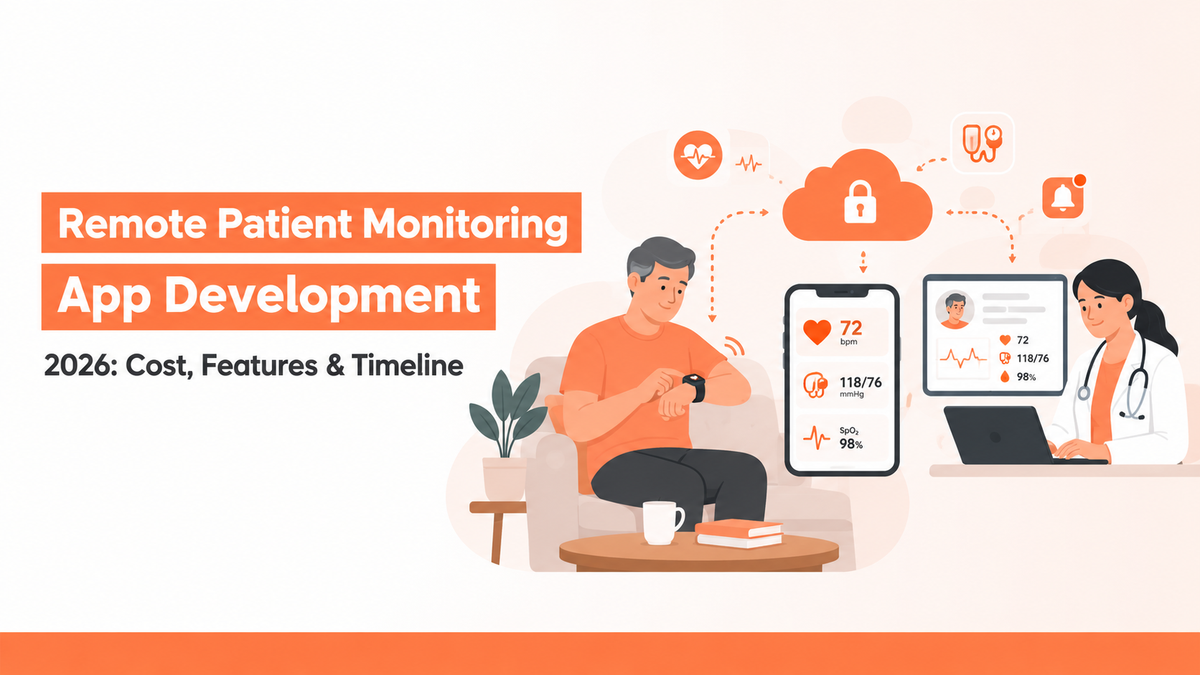
An RPM product is really three pieces of software working together: an app the patient uses at home, a dashboard the care team works from, and a back end that moves readings between devices, clinicians and the health record—most of the features below touch all three.
Devices that count for billing. Medicare only pays for readings sent automatically from a device that meets the FDA's definition of a medical device. That detail is easy to overlook, and it has already cost one company dearly. In a $1.29 million False Claims Act settlement announced in June 2025, one allegation was that patients typed their readings into a mobile app by hand. Most programmes today use cellular blood pressure cuffs, glucose meters, scales, and pulse oximeters that send data without the patient having to pair a phone, which tends to suit older patients much better than Bluetooth.
Wearable data, where it adds context. Smartwatch and ring data rarely qualifies for billing on its own, but it can add useful detail on sleep, activity and heart rhythm. On iOS, that data comes through Apple HealthKit, and on Android through Health Connect, since Google's older Google Fit APIs will only be supported until the end of 2026. We covered this in more depth in our piece on why the real value of wearable technology in healthcare lies in the data.
A patient app built for older users. Many RPM patients are in their seventies or older, so the app needs large text, few screens, clear reminders, and almost no setup. A reading history, medication reminders, secure messaging and short educational content cover most of what patients actually use.
A clinician dashboard that puts the sickest patients first. A nurse looking after several hundred patients cannot scroll through every reading, so the dashboard needs to rank patients by risk, show out-of-range readings at the top, and display trends over weeks so that one odd reading does not cause alarm.
Alerts with a clear owner. Set thresholds for each patient, assign every alert to someone, and record who saw it, when, and what they did next. That record matters for patient safety, and it is also what a practice will need to show an auditor who asks how an abnormal reading was handled.
Billing and time tracking built in. The app should count transmission days, log time spent talking with patients, and tell staff each month which codes each patient qualifies for under the 2026 rules.
EHR integration. Readings and care notes only help physicians when they show up in the record they already use, which usually means FHIR-based integration with systems such as Epic or Oracle Health. We have written separately about why EHR integration is the make-or-break factor for healthcare apps.
Outcome reporting. With programmes like ACCESS paying for results, the platform needs to show how a group of patients is doing over time, such as the share of patients with hypertension whose blood pressure is under control, alongside the usual counts of readings and minutes.
How Much Does RPM App Development Cost In 2026?
Most remote patient monitoring apps cost between $50,000 and $400,000 to build, and the spread is wide because "RPM app" can describe anything from a simple readings tracker for one clinic to a multi-condition platform that feeds a hospital's EHR. The ranges below reflect what we typically see for custom builds with a blended development team, and they assume HIPAA-grade security from the first release.
The build is only part of the budget, and running costs often catch teams off guard. Cellular devices usually come with a monthly data fee per patient, cloud hosting grows with every reading stored, and ongoing maintenance, security updates and compliance reviews tend to add around 15% to 20% of the original build cost each year. Anyone planning a programme should model those costs per enrolled patient, since that figure, set against the monthly reimbursement for each patient, determines whether the programme pays for itself.
What Pushes The Cost Up
Two RPM apps with similar screens can end up with very different price tags, and the difference almost always comes from the work that sits behind the interface.
The number and type of devices. Each new device model means another integration to build, test and maintain, usually costing somewhere between $5,000 and $15,000. Working through a device aggregator that already connects to many manufacturers can bring that down, though it adds a per-device fee that grows as the programme scales.
EHR integration. Sending readings one way into Epic or Oracle Health is a manageable project, while full two-way sync, where orders, care plans and notes flow back into the app, can easily double the integration budget. Health systems also run their own security reviews and app approval processes, which add weeks that you need to plan for early.
HIPAA compliance and security. Encryption, role-based access, audit logging, and business associate agreements with every vendor that touches patient data are requirements from day one, and building them in from the start is far cheaper than adding them after launch. Our guides to HIPAA-compliant AI and to private vs public cloud for healthcare go into the infrastructure choices in more detail.
FDA considerations. Software that simply collects readings and shows them to clinicians generally falls outside FDA device rules. Software that diagnoses a condition or triggers urgent escalation on its own may count as a regulated medical device. The FDA's updated clinical decision support guidance from January 2026 gave developers more room in some areas, . Still, iteft time-critical alerts under closer rules, so any product that plans automated escalation should get regulatory advice before the design is final.
AI features. Risk scoring, trend detection and automated summaries of a month's readings are where RPM platforms are heading, and they save care teams real time. They also add model development, validation and ongoing monitoring, and every AI output that reaches a clinician needs to be explainable and reviewed by a person.
Where the team is based. Hourly rates for experienced healthcare developers vary widely by region, and a blended team, with product and clinical workflow design close to the client and engineering offshore, is often how mid-sized projects stay within budget without cutting corners on quality.
How Long It Takes To Build An RPM App
A mid-sized RPM platform usually takes six to nine months from the first workshop to a live pilot, and the work typically splits across five stages.
- Discovery and clinical workflow design (3 to 5 weeks). This is where the team agrees which conditions the programme covers, which devices it will use, who responds to an alert and within what time, and which billing codes the practice expects to use. Skipping this stage is the most common reason RPM projects are rebuilt later.
- UX design and architecture (4 to 6 weeks). Patient screens are tested with people close in age to the real users, and the data model, security design, and integration plan are finalised.
- Development and device integration (12 to 20 weeks). The patient app, clinician dashboard, device connections, alert engine and billing logic are built in parallel, usually in two-week cycles with a working demo at the end of each.
- EHR integration, security testing and compliance review (4 to 8 weeks). This stage often overlaps with development, but the health system's own security review and app approval can set the pace.
- Pilot and scale-up (6 to 12 weeks). A small group of patients and clinicians uses the app in real care, showing where alert thresholds, onboarding, and staffing need to change before the programme opens to everyone.
A narrow MVP for a single clinic can move through the same stages in three to five months, while enterprise platforms with several conditions and two-way EHR sync commonly take a year or more.
Where RPM Projects Usually Go Wrong
Most RPM programmes that struggle do so for reasons that have little to do with the code itself, and nearly all of those reasons can be designed for in advance.
Patients stop sending readings. Engagement drops off over time in almost every programme. In the same American Journal of Managed Care study that reported strong blood pressure results, 3,403 patients started the programme, and only 1,594 were still engaged after a full year, which is under half. A simple setup, cellular devices that work out of the box, gentle reminders, and regular contact with a nurse all help, and the app should flag patients whose readings are tailing off long before they fall below the billing threshold.
Parts of the service never happen. When the HHS Office of Inspector General reviewed Medicare RPM claims, it found that 43% of patients did not receive all three parts of the service: setup and education, device supply, and treatment management. Readings that nobody reviews do little for the patient, so the platform should make it hard for anyone to stay enrolled without a clinician looking at their data each month.
Care teams drown in alerts. Overly sensitive thresholds produce hundreds of alerts a day, and staff quickly learn to ignore them. Per-patient thresholds, alerts grouped by severity, and a clear owner for each one keep the workload realistic, and they matter more as the patient panel grows.
Billing runs ahead of the care. Regulators are paying close attention, and the OIG's August 2025 report set out warning signs it now tracks, such as billing for many patients with no prior history at the practice and billing for several devices a month for one patient. An RPM platform that records who ordered the monitoring, why it was medically needed, and exactly how each billed minute was spent gives a practice the documentation it needs if a claim is ever questioned.
Building An RPM App That Lasts
Remote patient monitoring in 2026 sits in a better position than at any point since Medicare first covered it. New short-duration codes pay for monitoring that used to go unbilled, the ACCESS model rewards providers for results in chronic care, and clinical evidence keeps getting stronger. At the same time, regulators are watching billing closely, and patients drift away from programmes that feel like hard work.
The apps that do well in this environment tend to share a few traits. They use qualifying devices that send data automatically, give care teams a short, well-ranked list of patients to act on, track every billed day and minute with a clear audit trail, and push readings into the EHR where physicians already work. Getting those foundations right usually matters more to a programme's success than any single feature on the patient's screen.
If you are also weighing virtual visits alongside monitoring, our guide to telemedicine app development in 2026 covers how the two fit together.
At TechEssentia, we help healthcare providers and digital health companies design and build HIPAA-compliant remote patient monitoring platforms, from device integration and clinician dashboards to EHR connectivity and billing logic built around the 2026 Medicare rules. If you are planning an RPM programme or rethinking one you already run, talk to our team for a scoped estimate based on your conditions, devices and patient numbers.